
On-premise hotel laundry versus outsourcing — making the right call
The decision to build an on-premise laundry or outsource to a commercial plant depends on more than just cost per kilogram.
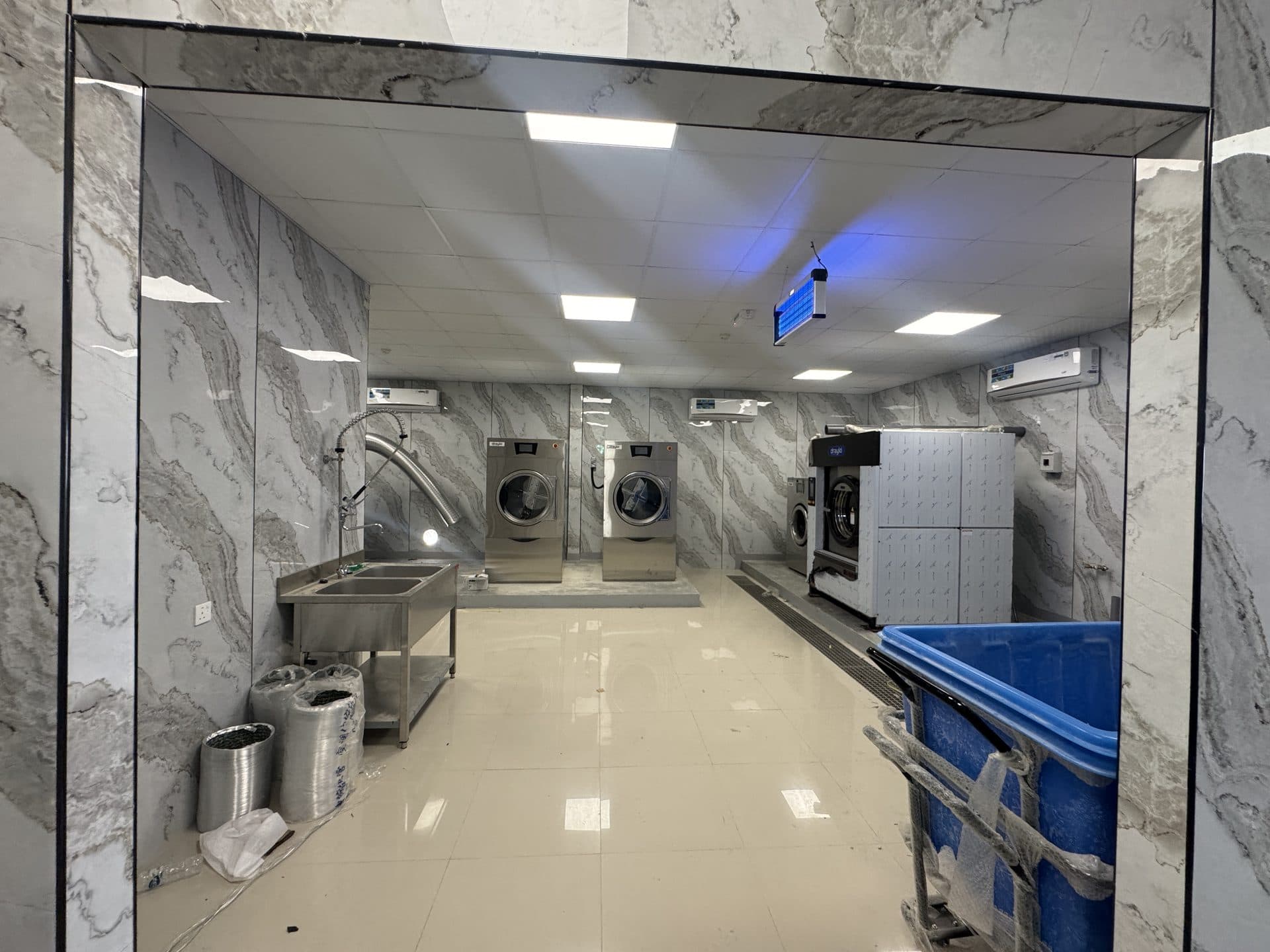
Every hotel operator faces the question at some point: should we process our own linen, or outsource it to a commercial laundry? The answer is rarely straightforward, and the financial analysis alone does not capture the full picture.
We have helped hotels go both ways — building on-premise laundries for properties that need control, and advising operators to outsource when the numbers and circumstances favour it. Here is how we think about the decision.
The case for on-premise
On-premise laundries give the hotel direct control over quality, turnaround time, and linen management. When a guest spills wine on a tablecloth at dinner, the restaurant can have a replacement back in service by breakfast. When housekeeping discovers a shortage during a peak check-in day, the laundry can prioritise a wash cycle.
This control matters most for luxury properties where linen quality is part of the guest experience. Ironing standards, folding consistency, and fabric care all suffer when linen is trucked to a remote facility, processed in bulk alongside other clients, and returned on a fixed schedule.
The financial case for on-premise strengthens as the hotel grows. A 400-room resort with multiple F&B outlets and a spa generates enough linen volume to justify a dedicated facility. The cost per kilogram processed on-premise is typically lower than outsourcing once the volume exceeds a breakeven point — usually around 800 to 1,000 kilograms per day.
The case for outsourcing
Smaller hotels — under 150 rooms with limited F&B — often cannot justify the capital and space required for an on-premise laundry. A washer-dryer-ironer line, the utility connections, the ventilation, and the staffing add up quickly. If a reliable commercial laundry is available within a reasonable distance, outsourcing can be more economical.
Outsourcing also makes sense during the early years of a new property when occupancy is ramping up. The hotel avoids the capital expenditure and can switch to on-premise later if volumes justify it.
The hidden factors
Beyond cost per kilogram, several factors influence the decision. Space is one — an on-premise laundry requires floor area that could otherwise generate revenue (a meeting room, a spa treatment room). Utility capacity is another — laundries consume significant water, gas or steam, and electricity. If the building's utility infrastructure is already at capacity, adding a laundry may require expensive upgrades.
Linen loss is a factor that operators sometimes underestimate. On-premise laundries typically have lower linen loss rates (1 to 2 per cent) than outsourced services (3 to 5 per cent), because the linen never leaves the property. Over a year, the difference in replacement costs can be significant for a large hotel.
Our recommendation
We advise operators to model both scenarios with realistic assumptions — not just current occupancy, but projected occupancy at year three and year five. We also recommend visiting the outsourced laundry provider's facility before signing a contract. Processing quality varies significantly between operators, and the cheapest provider is not always the best fit for a luxury property.
If the decision is to build on-premise, we design the laundry with future growth in mind — oversizing utility connections and leaving space for additional machines, even if they are not installed on day one. The cost of building in capacity from the start is a fraction of the cost of retrofitting later.
Whatever the decision, it should be made early in the project — because the space, utility, and structural requirements of an on-premise laundry need to be incorporated into the building design, not squeezed in as an afterthought.
Related articles
Factors to consider before investing in laundry equipment
Capacity, system design, MEP, and after-sales support matter more than a spec-sheet comparison. How to size a laundry investment that still works in year five.
Read article
From linen weight to machine line — modelling laundry throughput
Hotels and hospitals rarely have a single peak number. Building scenarios for occupancy, linen mix, and growth before sizing washers and ironers.
Read article
Proofing, ovens, and cooling — balancing a bakery line for consistent output
Bottlenecks often hide between proofer and deck oven. Aligning timing, floor space, and staff movement for artisan and scaled production.
Read article