
Guide: volume catering
Catering equipment for volume production: cook, chill, hold and move
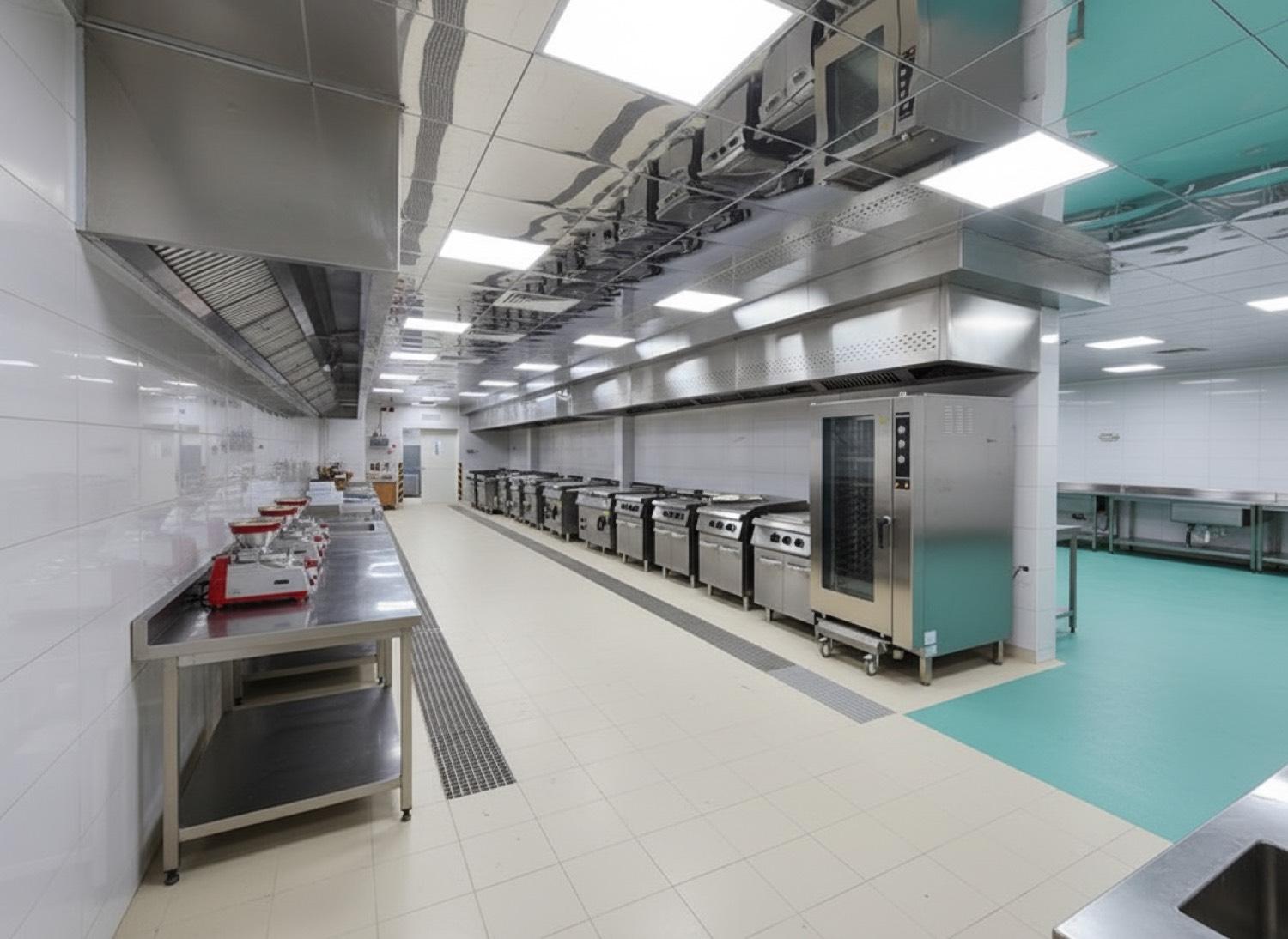
For catering companies feeding labour accommodation, schools, offices and events, the equipment has to do four jobs in sequence: cook in bulk, chill safely, hold at temperature and leave the building on time.
Catering equipment for a restaurant and catering equipment for a contract caterer look similar in a catalogue, but they are bought for different reasons. A restaurant cooks to order. A caterer cooks a known menu in large batches, often hours before it is eaten and kilometres from where it is served. That means the critical machines are the ones that cook a whole batch at once, bring it down to safe temperature quickly, and keep it hot or cold until it reaches the plate.
This guide is for catering companies supplying labour accommodation, school and nursery meals, corporate canteens and events across the UAE. It covers the production decisions, a checklist for the line, and the decisions to settle early. If you are planning a full central kitchen, our central kitchens service page covers the design side, and Al Rumooz can supply, fabricate and install the whole facility from our base in Mussafah, Abu Dhabi.
Batch cooking: fewer, bigger vessels
In volume catering, a row of burners with pots is slow and hard to control. Tilting bratt pans handle frying, braising, sautéing and shallow cooking for large quantities, and tip their contents into GN pans or containers. Boiling pans with indirect heating cook rice, lentils, soups, curries and sauces without scorching the bottom, which matters on dishes that are stirred less often. Commercial rice cookers take a staple off the hob entirely, and stock pot stoves carry the heaviest pots at a safe working height.
Gas or electric is a site decision as much as a menu one. Our bratt pans and boiling pans come in both. Gas gives fast heat-up where a supply exists; electric suits sites where gas is not available or the building restricts it, but the electrical supply has to carry the load of several large vessels running at once.
Cook-chill: the step most caterers under-size
Cook-chill means cooking ahead, cooling food quickly, storing it chilled, and reheating it close to service. It lets a kitchen spread production across the day and makes school and contract menus easier to plan. The weak point is almost always chilling. A full bratt pan of rice or curry left to cool in a normal chiller warms everything around it and stays in the danger zone for too long.
A blast chiller freezer is sized to the weight of food that comes off the line in one go, and its cycle has to fit between batches. Plan cold storage for what the blast chiller produces, and keep cooked, chilled food separate from raw stock. The time and temperature limits come from your food safety plan and the authority's requirements; in Abu Dhabi that is ADAFSA, so confirm the current rules with them.
Hot holding and transport
Food served the same day is cooked, portioned into GN pans, and held in heated cabinets or hot trolleys until the vehicle is loaded. Cold items, salads and desserts go into cold trolleys or chillers. Because GN pans are standard sizes, the same pan can move from the cooking line to holding to dispatch without decanting, which saves time and reduces handling.
At the serving end, bain maries with sneeze guards keep food at temperature on the counter in a canteen or labour camp dining hall. Plan the dispatch area so trolleys wait near the loading door without blocking the kitchen.
Catering production line checklist
Receiving and storage
- A platform scale and receiving table at the loading door.
- Separate cold storage for raw meat and poultry, produce, dairy, and cooked chilled food.
- Freezers or a freezer room for frozen stock.
- Stainless or wire shelving off the floor for dry goods in bulk.
Preparation
- Separate raw and ready-to-eat prep areas, each with sinks.
- A potato peeler, food processors, meat mincers and a bone saw if you portion meat in house.
- A vacuum marinator for marinated meat dishes at volume.
Cooking
- Tilting bratt pans and boiling pans for the bulk of the menu.
- Rice cookers and stock pot stoves.
- Convection ovens for trays of baked dishes.
- Fryers and griddles only if the menu needs them, as they slow volume production.
- Exhaust hoods with fresh air over the whole cooking area, and floor drains in front of tilting equipment.
Chill, hold and dispatch
- Blast chiller freezers sized to your largest batch.
- Heated cabinets and hot trolleys for hot dispatch.
- Cold trolleys for salads, desserts and chilled items.
- A date labeller for batches and portions.
- GN containers in quantity, in the sizes your holding equipment takes.
Washing
- A hood-type or conveyor dishwasher, or a utensil washer for GN pans and trays.
- Pot wash sinks large enough for the biggest pans.
- Grease traps and floor drainage sized for heavy use.
Decisions that shape a catering kitchen
Settle these early. Each one changes the equipment list, the utilities and the room, and they are hard to reverse once the kitchen is built.
| Decision | Options | Choose by |
|---|---|---|
| Production model | Cook-chill, or cook and serve the same day | How far food travels, how many service times you cover, and whether you want to spread cooking across the day |
| Batch equipment | Tilting bratt pans, boiling pans, rice cookers, stock pot stoves | The dishes on the menu and the meals needed in your busiest single window, not the daily total |
| Heat source | Gas or electric bratt pans, boiling pans and ranges | What the site supplies and the building allows, and how many large vessels run at once |
| Cold storage | Upright chillers and freezers, or cold rooms | Volume of raw stock and chilled cooked food, and how they are kept apart |
| Holding and dispatch | Heated cabinets, hot trolleys, cold trolleys | How many sites you deliver to, how often, and how long food waits before it leaves |
| Stainless steel | Standard catalogue tables and sinks, or made to measure in our workshop | The shape of the room, columns and drainage positions |
| Room to grow | Equip for today, or leave space and utility capacity for another bratt pan or blast chiller | Contracts you expect to add; extra capacity in the services is far easier to plan now than to add later |
Volume catering equipment in our catalogue

Freddolux Commercial Double Door Cold Trolley CTSDB-2
- Brand:
- Freddolux-Italy
- Model:
- CTSDB-2
- Size (W × D × H):
- 1627 × 951 × 2030 mm

Freddolux Commercial Single Door Cold Trolley CTSDB
- Brand:
- Freddolux-Italy
- Model:
- CTSDB
- Size (W × D × H):
- 877 × 950 × 2030 mm

Freddolux Commercial Blast Chiller Freezer BCF3
- Brand:
- Freddolux-Italy
- Model:
- BCF3
- Size (W × D × H):
- 660 × 650 × 420 mm

Freddolux Commercial Blast Chiller Freezer BCF5
- Brand:
- Freddolux-Italy
- Model:
- BCF5
- Size (W × D × H):
- 800 × 822 × 1035 mm
Freddolux Commercial Blast Chiller Freezer BCF14
- Brand:
- Freddolux-Italy
- Model:
- BCF14
- Size (W × D × H):
- 820 × 760 × 1850 mm

Freddolux Commercial Blast Chiller Freezer BCF10
- Brand:
- Freddolux-Italy
- Model:
- BCF10
- Size (W × D × H):
- 800 × 815 × 1645 mm

Vitalia Commercial Indirect Heating Electric Boiling Pan VKTE150
- Brand:
- Vitalia-Italy
- Model:
- VKTE150
- Size (W × D × H):
- 800 × 900 × 900 mm
Vitalia Commercial Indirect Heating Gas Boiling Pan VKTG150
- Brand:
- Vitalia-Italy
- Model:
- VKTG150
- Size (W × D × H):
- 800 × 900 × 900 mm

Volker Commercial Single Door Hot Trolley HTSD
- Brand:
- Volker-Italy
- Model:
- HTSD
- Size (W × D × H):
- 672 × 830 × 1776 mm

Volker Commercial Single Door Hot Trolley HTSDB
- Brand:
- Volker-Italy
- Model:
- HTSDB
- Size (W × D × H):
- 720 × 900 × 1780 mm

Volker Commercial Double Door Hot Trolley HTSDB-2
- Brand:
- Volker-Italy
- Model:
- HTSDB-2
- Size (W × D × H):
- 1627 × 950 × 1776 mm

Vitalia Commercial Free Standing Tilting Gas Bratt Pan VDTG890
- Brand:
- Vitalia-Italy
- Model:
- VDTG890
- Size (W × D × H):
- 800 × 900 × 900 mm
Common questions
Planning a catering kitchen?
Tell us how many meals you produce, for whom, and whether you cook-chill. We will reply with an equipment plan and the next step.
Request a quote
Name and phone are enough to start. Our team calls you back to scope the job.