
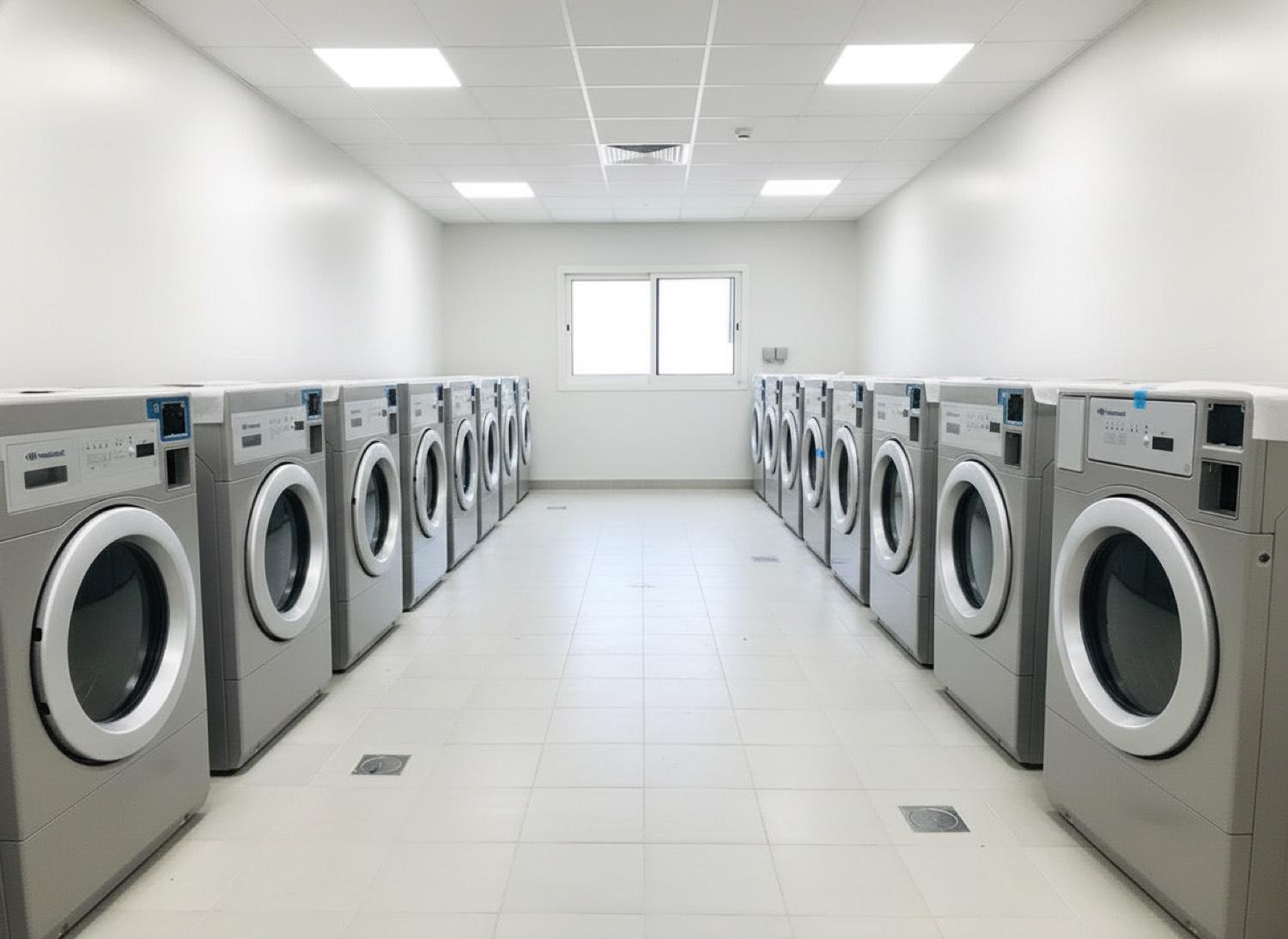
Guide: hotel laundries
How to set up a hotel laundry room, step by step
A practical sequence for planning an on-premise hotel laundry in the UAE, from the first linen count to the day the machines are handed over, written by the team that supplies and installs them.
Knowing how to set up a hotel laundry room comes down to one idea: linen should travel in one direction. Soiled bags come in at one door, get sorted, washed, dried, finished and folded, and leave as clean stock without ever passing back through the dirty side. Almost every problem we are asked to fix in an existing hotel laundry is a room where that line folds back on itself.
This guide follows the order in which decisions need to be made. Some of them, such as drainage and the electrical supply, have to be settled months before any machine is delivered, which is why they come early. Al Rumooz supplies and installs commercial washers and dryers from Mussafah, Abu Dhabi, for hotels across the UAE, and the steps below are the ones we walk through with hotel engineers and housekeeping managers.
Hotel laundry setup in eight steps
Decide what the laundry will wash
Guest bed linen and towels, F&B table linen, pool towels, bathrobes, staff uniforms, or all of them. Some hotels wash towels and uniforms in house and send sheets out. The scope changes everything that follows, so agree it with housekeeping and F&B first.
Measure the linen in kilograms
Weigh one of each item, multiply by the daily counts, and use the busiest day of the week at full occupancy. That peak-day weight is the number every machine is sized from. Our Dubai laundry page sets out the sizing method in detail.
Choose the room
Close to the service lift and the linen stores, away from guest areas because laundries are warm and noisy, and where water can drain away by gravity. Basements and ground floors are common. On upper floors, soft-mount washers are the only practical choice.
Draw the linen flow
Mark the soiled entry, a sorting area with space for carts, the washers, the dryers, a finishing and folding table, clean shelving and the clean exit. Keep the dirty side and the clean side on opposite ends of the room, with the machines between them.
Fix the utilities
Water supply and pressure, drain capacity, electrical load, dryer exhaust, fresh air, and chemical dosing points. Your MEP engineer needs each machine's data at this stage, not after delivery. The checklist below lists what to confirm.
Select the machine mix
Two or more washer extractors of different sizes rather than one large drum, so a breakdown or a service visit does not stop the laundry and small urgent loads are not run in a big machine. Dryers sized so their combined capacity keeps up with the washers. Ironing and folding equipment only where finish quality or volume justifies it.
Plan staffing and shifts
Schedule washing around when housekeeping strips rooms and when clean linen is needed back on the floors. Someone has to sort, load, unload, fold and stack, and those jobs clash if the room is too tight for two people to pass. Leave room for carts to wait without blocking an aisle.
Install, commission and train
Machines are positioned, levelled or fixed, connected and test-run on real loads. Staff are shown programmes, loading, cleaning lint filters and daily checks. A preventive maintenance schedule starts from handover, because a hotel laundry works every day of the year.
Hotel laundry utilities checklist
Confirm each line with your MEP engineer and the building before ordering. Exact requirements come from the data sheet of each machine you choose.
Water
- Cold supply at the pressure the washers need, and hot water if the chosen machines use it.
- Isolation valves at each machine so one can be serviced while the others run.
- Water quality checked: hard water affects wash results and machine life, so ask whether softening is advisable.
Drainage
- A drain or trench sized for several washers discharging at the same time.
- Floor falls towards the drain, so spills do not sit under the machines.
- Lint screening where the drain could block.
Power and heat
- An electrical supply rated for the heating load of every washer and dryer that may run together. The machines in our range are electrically heated.
- Steam, only if the plan includes steam-heated ironers or finishing equipment.
- Dedicated circuits and isolators at each machine.
Ventilation
- A separate exhaust duct for each dryer, run to outside by the shortest route.
- Fresh air into the room to replace what the dryers exhaust.
- General extraction or cooling, because a laundry in a UAE summer gets very hot without it.
Structure and finishes
- A concrete base for hard-mount washers, or confirmation that the floor suits soft-mount machines.
- Washable, non-slip floor and wall finishes.
- Door widths and a delivery route large enough for the biggest machine.
Common hotel laundry mistakes
Mistake
Sizing machines from the number of rooms instead of the weight of linen.
Do this instead
Weigh real linen on a peak day. Rooms with bathrobes, extra towels or frequent changes produce much more than a simple count suggests.
Mistake
One large washer for everything.
Do this instead
Use at least two machines. When the only washer is down, the hotel runs out of linen within a day.
Mistake
Dryers that cannot keep up.
Do this instead
Compare dryer cycle times with washer cycle times. If wet linen waits for a dryer, the washers stand idle regardless of their size.
Mistake
Dryer exhaust planned last.
Do this instead
Route the ducts before the ceiling is closed. Long, bent duct runs reduce drying performance and collect lint.
Mistake
Clean linen folded next to the soiled sorting table.
Do this instead
Keep the clean side physically separate, ideally with its own exit, so finished stock is not handled near soiled bags.
Mistake
No space left around the machines.
Do this instead
Allow access behind and beside each machine for the technician, and space at the front for loading carts.
Common questions
Planning a hotel laundry?
Send us the room plan, what the laundry will wash and your peak-day linen count. We will suggest the machine mix and list the utilities your engineer needs to prepare.
Request a quote
Name and phone are enough to start. Our team calls you back to scope the job.